Showing posts with label Wittgenstein. Show all posts

Wednesday, 21 April 2010

The Myth of the 'Philosophical Investigations'


1.  The World (language) is a Labyrinth in which the Lover and the Beloved continuously approach one another upon labyrinthine ways which equally continuously move them apart. 

The Purpose of the Investigations is to create a labyrinth of the “We” (‘language is a labyrinth of ways’) into which the ‘you’ is guided – conducted – seduced.  Every ‘you’ is a potential beloved of the lover waiting in his labyrinth. 
The lover=the Minotaur=the monster of the labyrinth.

Out of the ruins (of disciples) one builds a labyrinth – the centreless universe – the all-devouring monad – the plural monad.

Only by losing oneself in the labyrinth can one be found by the lover – you have to want to get lost before the lover can find you in the labyrinth.  Wanting to be lost creates in the potential beloved a vertigo of self-abandonment, surpassing any other sort of betrayal.  One places one’s own genetic uniqueness in the service of the genetic destroyer.  Is that a manifestation of the ‘death instinct’?  

The labyrinth is dark – darkest of all is the lover.
The Beloved is the light in the labyrinth.

The “We” is a labyrinth of (disembodied) voices – not necessarily in unison – but occasionally punctuating the darkness with a chorus-refrain or an amen – spoken as ‘we’ and at once in “Übereinstimmung”; the intimation, attuned and coinciding, coaxing and chiding the ‘you’ – the beloved – to ‘go on’. 

The voices of the labyrinth were once ‘you’.  They are now ‘we’ – the voices of the damned – the ghosts of the previous beloveds.  Once ‘you’ becomes a voice of ‘we’ – he becomes a previous beloved – no longer the present beloved.  These are the voices of the remembered loves.  The ‘We’ is the chorus of dead loves.

When the ‘you’ of the beloved becomes a voice of the ‘we’ in the labyrinth, the ‘you’ dies as a beloved but the lover=philosophy dies for the ‘you’ as well.  Or the ‘you’ does not know itself anymore.  It is an atom of the ‘we’ of the seducing chorus.  Which is the same thing as saying – the lover has died for the ‘you’.  Only the next ‘you’ will revive the lover for the time in which the ‘you’ still resists becoming a ‘we’.

For the lover is also the hunter of the beloved – and what the lover hunts is the Will.
This leads to Bruno – the myth of Actaeon.  The chorus of dead loves are those who have received the mystical ‘mors osculi’ – death of the kiss. 

2.  In the negative cosmology of Bruno, Hell is part of God.  His ideas finally entered English thought some 50 years after his death during the time of the English Revolution via the ‘teutonick philosophy’ of Jakob Böhme.  The annihilation of the soul – as portrayed in the drama of Faust – is a desired end.  Mystical enlightenment comes only in the deepest darkness.  Divine grace is to be found in the depths of hell because that is where “God shall retire himself within his own Center, to be truly Hell.” (“An Introduction to the Teutonick Philosophie”, C. Hotham, March 3, 1646 – Dispute at Commencement in Cambridge)

Ludwig Wittgenstein revived certain aspects of the ‘teutonick philosophy’ when he began his teaching career at Cambridge in the 1930’s.  He found many young disciples willing to follow him along the ‘via negationis’, entrusting him with their malleable souls.   “My attitude towards him is an attitude towards a soul.  I am not of the opinion that he has a soul.” (Wittgenstein, Philosophical Investigations, Part II)
In the drama of their souls Wittgenstein’s role is never perfectly fixed.  Sometimes he appears to be Faust, sometimes Faust’s tactless crude apprentice Wagner, but more often Mephistopheles.  Wittgenstein is not evil, but he sees with the eyes of the Evil One – very far.  Who is really in charge of the obedience of ‘bare life’ if not the Master of Hell – where and by whom are the damned punished?  God may write the Law, but Satan enforces it.  Wittgenstein is the mystical personality – he transmutes evil into good and good into evil until the question of good and evil collapses into absurdity.  One of Wittgenstein’s sources for his ‘negative political theology’ is the vision of Church jurisdiction expressed by Ivan Fyodorovich in Dostoyevsky’s “The Brothers Karamazov”.  In a discussion in the cell of the holy man Starez, the simple monk Vasij sketches the utopia of the Church-State:  “It’s not the Church which will turn into the State (…)that’s Rome and its dream.  That is the third temptation of the devil!  On the contrary, the state turns into the Church, advances itself to Churchhood, and becomes a Church covering the whole earth.  This World Church is completely opposed to the ultramontanism of Rome and is reserved for the Orthodoxy on earth.  Light will come to the world from the east.” (Dostoyevsky, Die Brüder Karamasow, München, 1978, p. 93)

The mystical personality is a person who has a general reputation for being very virtuous, self-sacrificing, almost unnaturally good, no matter how much evidence to the contrary.  Anything he does or is no matter how remote from the conventional notion of good will always be interpreted in a positive or logical light.  This is the very essence of his negative influence.  The ‘essence of negation’ which eluded Wittgenstein in his philosophical writings – is captured in his life.  He speaks through his interpreters and they declare his words to be oracular.  The first sacrifice required of Wittgenstein readers is sacrificium intellectus.  As Cavell writes in “The Claim of Reason”: “(…) Wittgenstein’s writing is, as certain of his readers had shrewdly suspected from the beginning, beyond rational criticism.” (Stanley Cavell, The Claim of Reason, Oxford, 1979, p.20)
His personality is a paradox because his kind of dialectical harm, which is generally recognized as good, is a cause of holiness in others.

The proof of true love is the breaking of the will of the other.  Through his ability to break the will of others, without necessarily imposing his own will in its stead; the mystical personality is a prime mover of fate.  He is the embodiment of the negative principle.  He nullifies his ‘victims’, he does not posses them.  The negative principle is not the essence of the mystical personality – it is his prestabilized fate.  He may try to evade it in his youth when it is less obvious – being simply disguised by youth and its excessive vigour.  When the lethargy and solitude of age set in, the true mystical personality begins to shine through.  The mystical personality can no longer hide behind the living, it is reclaimed by the worlds beyond. 

The ‘riddle of evil’ is very close to the ‘riddle of holiness’.  To measure their nearness one must first familiarize oneself with certain principles and methods derived from a negative theology of coincidentia oppositorum (Nikolaus Cusanus, Giordano Bruno, Jakob Böhme) 

Negative Theology:  God is not redemption.  The Anti-Messiah.  Why shouldn’t there be a separate anti-force, which brings the Anti-Redemption.  With all the magnificence of the Redeemer?  Not Lucifer – he isn’t the expected one.  But a figure about whom prophecies have been uttered – a figure of the future.  As Nietzsche’s Zarathustra says: “Oh that someone would save them from their Saviour!”.  The characteristics of the Not Redeemer should be equally recognizable as those of the Redeemer.  The first axiom of negative theology – God is the Not-Redeemer, the star of not-redemption.   


Tuesday, 23 February 2010

Fraudulent Philosophy - Stanley Cavell on the Modern in Art


Why is it that certain ideas become outdated more quickly than others – even if they are especially designed to show what it is to be ‘up to date’ as in Stanley Cavell’s writings on modernism in art?  Does this have to do with the general wasting away of  ‘ordinary language philosophy’ of which Cavell is a major proponent? (see T.P. Uschanov, “The Strange Death of Ordinary Language Philosophy”, 2002, online)  Could it be that those ‘methods’ applied to art naturally share the same fate?  Or are there more general laws of obsolescence at work?  How do ‘logics die’ even when they are not logical?

A consequence of Cavell’s imposing sincerity of intention or meaning upon the artist and the work of art is his claim to expose certain works as fraudulent. (in: “Music Discomposed”, Must we mean what we say?, Cambridge 2003)  He describes this claim as “empirical”, arrived at by his experience with works of art and artists of his time – ‘contemporary with the claim’.  He thus applies it only to what he judges to be modern art  – not to the past history of art, nor art in an atemporal plane.  Cavell’s criteria are not transcendental in the Kantian sense, meaning the apriori conditions of the possibility of aesthetic experience; he seems to be demanding of modern art that it make it possible for him to ‘believe’ it.   

His case for sincerity or fraudulence in art, something in itself intangible, not perceivable in the work,– rests on his particular use of  ‘intending’ or ‘meaning’ in a work of art.  He borrows this idea of art and sincerity from Tolstoy’s “What is Art?”.  The writings of Krenek on certain theoretical aspects of the “new music” are his main ‘exhibit’.  Cavell dismisses these writings as ‘fraudulent’ and by a vertiginous leap in his argument concludes that Krenek’s music is also fraudulent.  It is Krenek’s “philosophizing” which annoys Cavell – composers should compose and leave ‘philosophizing’ and magazine articles to the ‘professionals’.  But Cavell has nothing to say about Krenek’s music – or even how it reflects his ‘fraudulent’ theories.  This does not prevent him though from appropriating Krenek’s themes of “composition, improvisation and chance” as the structure for his own musings on composition and the modern.  (“But I was discussing some writing now current about the new music.  Perhaps I can say more clearly why it leads, or has led me, to these various considerations by looking at three concepts which recur in it over and over – the concepts of composition, improvisation and chance.”
“Music Discomposed”, op. cit. p. 193)

Against this idea of an artist or work of art meaning or intending something ‘x’ which he has to convey outside of the work itself to Cavell or any other interrogator, I would suggest the work of art has the form of an axiom and of a fact or as Badiou would say – an event.  Cavell or any other critic is only an adjunct of the art event – in this case of Krenek’s music and his reflexive process of composition.
 Cavell’s ‘meaning’ follows art and not the other way around. The art axiom creates a disruption or a voiding of received meaning, what time or history do in other ways.  The intention of the artist is that the work exist – nothing more or less.  If it exists it is not fraudulent.  Something always happens.

Maurice Blanchot who like Krenek questions the traditional romantic idea of ‘inspiration’ - says about the literary work of art in “The Space of Literature”: “However, the work – the work of art, the literary work – is neither finished nor unfinished: it is.  What it says is exclusively this: that it is – and nothing more.  Beyond that it is nothing.(…)The work is without any proof, just as it is without any use.  It can’t be verified.” (University of Nebraska Press, 1982, p. 22)

Cavell insists on some other meaning, not expressed by the work itself, which must satisfy his demand for sincerity.  But he only demands that ‘modern art’ pass his sincerity test.  ‘Traditional’ or established art is exempt.  Amongst the moderns – John Cage and Anthony Caro belong to Cavell’s protected species – perhaps on advice from the art critic Michael Fried.  Although certainly Cavell would not deny that even the judgements of ‘traditional art’ are in a constant state of flux.  What do Wordsworth’s effusions mean today even for the diehards of English romantic poetry or Ruskin’s condemnations of ‘the pestilential art of the Renaissance’ for neo-Victorians?  And why is it that only “(…)the experience of the modern is one which itself raises the question of fraudulence and genuineness(…)”? (“A Matter of Meaning It”, op. cit. p.214) Something Cavell takes to be “an obvious but unappreciated fact” (ibid.) – how is something both ‘obvious’ and ‘unappreciated’?  But if it were an obvious fact (and perhaps it is) - then the “experience of the modern” in philosophy is also overshadowed by questions of the fraudulent and the genuine…

Cavell is a Beckmesser who says what I cannot ‘hear’ or ‘see’ does not exist.  Lurking in the background of his not ‘hearing’ and not ‘seeing’ of certain modern art is Cavell’s presumption that art and religion are closely related if not identical – and that they are both exposed to belief or disbelief.  He expresses this negatively: “For religious experience is subject to distrust on the same grounds as aesthetic experience is (…)”(“Music Discomposed”, op. cit. p.191)  He thus transfers the ‘tests’ of his ‘empirical’ claims to the religious sphere, deftly evading verifiability. Once safely ensconced in religious sensibilities he then claims that modern art with all the emotions it arouses (especially hostility and disgust) must be treated as one does persons not objects.  “In emphasizing the experiences of fraudulence and trust as essential to the experience of art, I am in effect claiming that the answer to the question “What is art?” will in part be an answer which explains why it is we treat certain objects, in ways normally reserved for treating persons.”(op. cit. p. 189)

Paradoxically, although the universal tendency of modern art is towards abstraction or the ‘unhuman’ (especially music – the subject of his remarks) Cavell in his claims about fraudulence and genuineness (sincerity) in art retreats in the opposite direction - further into anthropomorphism.  (Cavell has imperceptibly widened his net to include all of art without further justifications.) 

His “aesthetic experiences” interrogate the ‘conscience’ of the artist.  Avant-garde art though defines itself as an ‘experimental’ production of new existences (art bodies).  His rules for modern art are mere private evaluations originating in incommunicable quasi-religious experiences – they have no hold on what art is.

One could say that Cavell is himself a victim of his desire to name everything at any price, a drive or obsession which Badiou calls ‘evil’.  How else is one to regard his insatiable lust for meaning of meaning of meaning and so on endlessly from a work of art?  Is this a Wittgensteinian stance?  Wittgenstein saw all meaning rather as indeterminate and necessarily admixed with elusive degrees of falsehood (fiction, myth).  In a similar spirit Wittgenstein confided to his publisher von Ficker that the most essential part of the Tractatus logico-philosophicus is what he had not written.  Would Cavell ‘the new Wittgensteinian’ have demanded that he spell it all out for him? 


Saturday, 26 December 2009

Notes on Powerlessness


Wittgenstein’s philosophy resembles baroque anamorphic painting. One might compare its effect with Holbein’s “The Ambassadors” - viewed from the front one sees a bishop and a nobleman in a palatial chamber, seen from the side, what appeared in the foreground to be a distorted wafer-shape on the floor metamorphoses into a large death’s head.

Wittgenstein’s life certainly was one of extremes – his philosophy though is one of limits, restrictions, rules and obedience. Bernard Burgoyne, referring to the early Wittgenstein, even before the Tractatus, when he was still a close associate of Bertrand Russell said – “Oxford, Cambridge, London was 'the golden triangle' - the power base for the intellectual elites, the Russell-Wittgenstein program was an 'imperialistic' one  - to lay foundations for all knowledge in this certain kind of logic - also using set theory. All that collapsed and failed. Wittgenstein lost his faith - his belief in it." [In conversation with the author, “Monadic Dialogues” from: “The Conference”, Sound Installation, Shannee Marks and Peer Wolfram, Exhibition, Part 1 of Faust Series Opus 8: The Accident Colony, Triptych from the Dark Night of Suburbia]

This collapse more or less coincided with the collapse of the Austro-Hungarian Empire and the secure world of wealth and power into which Wittgenstein had been born. It was also perhaps the last possible moment in British intellectual history when such an imperialistic program could have been conceived – the First World War was the first mortal blow to the British Empire. Wittgenstein’s Tractatus logico-philosophicus, written shortly after World War One, could easily be seen as a nihilistic credo of a writer whose power base has been shattered.

1. Powerlessness

If Wittgenstein’s philosophy is “will to power” – he begins at the ideal point of powerlessness. In his “War” Journal he meditates upon a paradoxical configuration – power at whose genesis is the complete lack or absence of power. When power is defined as energy applied to the world – moving outside of its source – then Wittgenstein’s initial state is one of total lack of energy, less even than a passive state – energy could still be present but inactive. His initial state is an unnatural vacuum – a state drained of all energy. This is a possible delimitation (definition) of Wittgenstein’s nihilism: a philosophy of power whose starting point is the state of powerlessness, the inability to influence events, the state of the world to any degree whatsoever.

“I cannot bend the happenings of the world to my will: I am completely powerless.” (11 June 1916 from Diaries 1914-1916, quoted in Lars Hertzberg “The Powerlessness of the Will”, online pdf, p.1)

This is an early expression of Wittgenstein’s “shattered power base”. Although no power is ever completely shattered. But perhaps the desire, which animates power – the intangible of power – a prerequisite of will – can be extinguished. As Nietzsche writes in “The Gay Science”: “(...)an imagination of desire (Lust) or lack of desire (Unlust) is necessary for will to exist.” (Nr. 127)

Is the relation between Wittgenstein’s “I” and “the world” reciprocal - perhaps “I” am completely powerless, but does that mean that the world cannot bend me to its “will”?  And if the world could do so, how am “I” different from the world – that I have absolutely no power to bend it to my will?
One is also uncertain if this powerlessness, to which Wittgenstein refers, is an original state or is it the consequence of a loss or failure of power? In the first case he would be describing a natural or ontological predestination, in the second he would be alluding to a kind of “fall” or total and complete decline of power. The world is a fait accompli, which happens without my intervention. The sentence which concludes this journal entry suggests that this separateness of the “I” and the world is not just undesirable.

“Nur so kann ich mich unabhängig von der Welt machen – und sie also doch in gewissem Sinne beherrschen – indem ich auf einen Einfluß auf die Geschehnisse verzichte.”
(“Only in this way can I become independent of the world – and so in a certain sense rule it – by forfeiting any influence upon events or happenings.”)

Wittgenstein’s “powerlessness” is one of an “I” who is distant from the world, who is outside of it, and by forfeiting closeness or influence, masters it on an oblique plane of his own choosing. He has become an onlooker or spectator of the world and even of his own will “penetrating” the world. He is outside of the world, but so is its meaning.

When Wittgenstein says he is powerless – he has placed himself in a sort of suspension – the world is no longer a natural envelopment or folding in which the I resides (Heidegger’s being-in-the-world), but the I has removed himself from the world, become unhumanized and indifferent to its happenings. The powerlessness can only be reciprocal if it is to be at all – reciprocal negatives. I am excluded from the world – in the sense of energy or power to transform it, the world is excluded from the “I” in the same way. The World is excluded from my power sphere; I am excluded from the World’s power sphere.

“I” may become independent of the world, but the world is independent of my will from the outset. The world is always ahead of me – the world is also Life, a word used by Wittgenstein in an almost pre-philosophical manner, like God. Philosophy can never touch Life, it happens to me whether I will it or not. Yet in an entry from 8.7.1916 Wittgenstein writes: “There are two Gods: the World and my independent I.” But how is it possible that both propositions are true: I am totally powerless and I am a co-divinity together with the world? He seems to oscillate between a state of abdication from the world and a kind of folie de grandeur, a Godlike omnipotence. But perhaps the world is not the world which is but one which was – as Wittgenstein says, the world is given to me; it is something completely “finished”.

One can assume that the past is the realm of pure actuality. Potentiality can only exist now (in not existing) or in the time to come. The past is only a limit to the potentiality inherent in the now. This may be a blessing - the “possible worlds” to come could be possible catastrophes – as Kierkegaard observes, actuality is not as heavy as possibility. Why does the expectation of possible worlds always sound utopian? Wittgenstein’s dilemma, already apparent in his Diaries, is how to turn his quantitative world into a world of qualities – Life. ‘The World and Life are one’ is a refrain of all his writings. But one is only “happy” when one lives in the present, meaning “unzeitlich”, not in time. He declares: “What do I care about history? My world is the first and only one!” (2.9.1916) And yet what will he do in his world? “I want to report, how I discovered the world as it is.”(ibid.)

The past is just as unknown as the future. Although one sees the future as that which one has to predict, to prophesy. Who would prophesy what has already happened? The past is the domain of pure actuality – all potentiality has been realised, exhausted in what is there. This is the world towards which no power can be directed – no power of whatever magnitude can change the past. Such a world of pure actuality would certainly fit Wittgenstein’s “homily” about his powerlessness. One can also see how his “will” would “penetrate the world” – certainly the world of the past has no resistance to one’s will. No possible worlds remain in the past – the past is exact and non-quantifiable, being the location of zero possibility, or zero terrain for the unfolding of power. The past as pure actuality is neither a means nor an end.

2. The Religion of Defeat

Wittgenstein resolves this antinomy of being both powerless and God-like after a fashion – abdication or forfeiting of influence upon events in the world is his declared way of regaining a certain kind of power in that world. Thus there is logic in his philosophical “will to power”, the logic of defeat. From the point of view of a defeated power – powerlessness is a natural and ideal starting point for a philosophical “reconquista”. The given world has no meaning because it is no longer the world in which I can see my power reflected or embodied. If Wittgenstein were to acknowledge the logical connection between Will and the world, he would be acknowledging his powerlessness within it. Instead his “nihilism” is not just the evacuating of meaning (ethics), power has also been voided. This is not an ambivalence – it is almost an ‘epoché’. He begins the analysis or reconstruction of power where it is absent – a kind of zero of power. He shows himself as a skeptic of a world constituted by power – perhaps as an exercise in method, a thought experiment.

Bare Life, the concept of Giorgio Agamben, educed from the phrase “bloßes Leben” (literally: mere life) in Benjamin’s “Critique of Violence” (“Zur Kritik der Gewalt”), is also a thought experiment about powerlessness, a juridical fiction – the absence of all power, pure subjugation to sovereign law. In Benjamin’s text “Gewalt” means both power and violence – Benjamin explores all the ambiguities, which arise from this double meaning. Agamben seems though to falsify and distort Benjamin’s critique of the notion of “mere life”. Whereas Benjamin rejects “mere life” as a false and crude name for Being (Dasein) and an inferior primitive category of “mythical violence” or law, Agamben naturalizes it further with another concept he borrows from ancient Roman law – homo sacer. Bare life, in his interpretation, is thus not just a kind of biological substrate of human existence; it is also a term for the criminal pariah – a species of Cain, who can be murdered by anyone with impunity, but perversely, not sacrificed.

Although Roman law may forbid the sacrificing of “homo sacer” – the mythical law to which Benjamin refers is particularly keen to sacrifice “mere life”. Agamben’s construct seems to fall apart at this joint. As Benjamin writes, “Die mythische Gewalt ist Blutgewalt über das bloße Leben um ihrer selbst, die göttliche reine Gewalt über alles Leben um des Lebendigen willen. Die erste fordert Opfer, die zweite nimmt sie an.” (The mythical power is a blood-power over mere life for its own sake; the divine - pure power over all life for the sake of the living. The first power demands sacrifices, the second accepts them.) (W. Benjamin, Zur Kritik der Gewalt, Angelus Novus, Frankfurt, 1966, p. 63)  Contrary to Agamben's interpretation of "bare life" as a juridical object - for Benjamin "mere life" is not an object of law at all, rather the dissolution of law.  "Denn mit dem bloßen Leben hört die Herrschaft des Rechtes über den Lebendigen auf."  (Since with mere life the rule of law over the living is terminated.) (ibid.)

This doubly bare figure – bare of all protection by law (the law of no law) and of anything besides naked existence is Agamben’s prototype of the “biopolitical” animal. He is both a natural body and a mere naked scaffold for the law. How though did a particular type of ostracism and taboo practiced in ancient Rome suddenly become the absolute model for the relation between the contemporary body and sovereign power? The way this happened, says Agamben, is through the “Camp”. The “Camp” was the space, which constituted the Nazi state as a permanent normalized “State of Exception” where the exception became the rule. Agamben notes that this so-called “state of exception” was constantly superseded by the positive principle of “Führung” or the word of the Führer, the only “law” of the Nazi political entity. In light of this one real fact of the “Führer”, the “Camp” was not outside of the State in a “zone of indistinction” but at its center. Modern democracies are in Agamben’s estimation forever more just aggregates of this “bare life” invented in the “Camp”.  Agamben would appear to depart here from Roberto Esposito, another Italian proponent of bio-politics, who sees the emergence of a bio-political paradigm as a replacement for democratic models.  In either case 'bio-politics' is a juridical and physical mode of absolute powerlessness of the individual and absolute power of the state.  The question arises - does one even 'need' power?

What Agamben omits from his treatment of "The Camp as Biopolitical Paradigm of the Modern" is the contradictory self-defeating purpose of the  German Nazi “Camp” – as the location and housing of genocide, its “success” could only lead to its own destruction together with its raison d’être. Not the “Camp” but a unique historical act of genocide was the instrument by which “ (…)the German biopolitical body is made actual. The separation of the Jewish body is the immediate production of the specifically German body, just as its production is the application of the rule.” (Homo Sacer, Sovereign Power and Bare Life, Stanford University Press, 1998, p. 174)   Agamben also fully neglects the crucial economic and geo-politic significance of the whole concentration-and-death-camp system for Nazi “Bio-Economics” - Auschwitz itself consisting of a network of 48 camps was an immense industrial park, where gas chambers and crematoria were next door to the most important German heavy industry such as Buna Werke, a part of the I.G. Farben group.  The SS administered the Auschwitz complex as its private fiefdom.

Such a life could never exist in a pure state. Bare Life does not live. That is why Agamben has to prop up his 'paradigm of the modern'  with “Sovereign Power” as its symbiotic twin – the model for this Sovereign Power is predictably the Führer. The more abject and abandoned Bare Life is, the more grandiose the “sovereign power” which exerts its ban. The Muselmann and the Führer are forever dialectically united as the “two bodies of the King”.   Together they haunt modernity.  In a similar but inverted way - “Empire” as imagined by Negri and Hardt is so bloated so as to be the guarantee of the equivalent dimensions of a global Revolution.

By connecting “biopolitics” so irrevocably and enthusiastically to Nazi extermination politics, it would appear that Agamben has brought this staple of contemporary Italian-French political theory somewhat into disrepute. Negri has distanced himself explicitly from the notion of “nuda vita” in both “Empire” and in “Il mostro politico. Nuda vita e potenza”.   In “General Intellect, Exodus, Multitude” Paolo Virno writes: “(…) Agamben is a problem.” (see Brett Neilson, Potenza Nuda? Sovereignty, Biopolitics, Capitalism in Contretemps 5, December 2004)

Like Wittgenstein at the beginning of the 20th century, these mostly Italian thinkers of a “post Fordist”, post-Marxist left, have developed their philosophies out of a perceived collapse or defeat of their world and its movement. In his foreword to Virno’s “Grammar of the Multitude” another seminal text of this Italian revival of political (state) theory, Sylvère Lotringer writes: “Clearly they needed an oversize enemy to build up the defeated Italian movement into a global counter power.” ( in: Paolo Virno, Grammar of the Multitude, MIT Press, 2004, p. 14)

Besides, “Empire” as Negri/Hardt see it, is also a product of “defeated” nation-states, dissolved and metamorphosed into generic labyrinthine supranational entities. Two defeats would appear to make one victory. This is a clear logic of defeat, or something which only defeat can give the semblance of logic. The euphoria of defeat resting its case on such a deluded logic sweeps its victims forward into a self-deceiving drive for power. Such phenomena akin to mass hysteria are not uncommon in history. The fascist movement in Germany came out of the defeat in World War I – to defeat the defeat. Fascism itself is not the cause; it is a phenomenon of defeat. Similarly, as Nietzsche said, nihilism is not a cause; it is the “logic of decadence”. Fascism appears to its ‘World’ as a messianic cure for decadence – miraculous rejuvenation. Total defeat is discovered to be an untapped source of energy from which world power can be regenerated – this is a true discovery having to do with the mysteries of the human will. Nietzsche was a prophetic thinker who radiated euphoria more typical of defeat than victory. He was also an acute observer of the manifold unconscious ways of self-deception, the 700 passions of defeat.
“Everything is false! Everything is allowed!" (Carl Hanser Verlag, München-Wien, 1980, Volume 6, Posthumous Writings from the Eighties, p. 424)

He noticed a nearly biological propensity to overestimate the power of the will in any exercising of the will:
“Weil man in den allermeisten Fällen nur will, wenn der Erfolg erwartet werden kann, wird die 'Nothwendigkeit' des Erfolgs dem Willen als Kraft zugerechnet.”
(“As one mostly only wills something, when success can be expected, the ‘necessity’ of success is credited as an additional power to the will.”, Posthumous Fragments, Summer-Autumn, 1884)

3. “Discounting Defeat” (Adorno)

Where does the unchangeability of money come from? Money cannot be modernised – only the means of exchange, payment can vary. Discounting still remains discounting. Credit notes are exchanged for cash. Adorno suggests that money in its credit form has the structure of preemptive revenge – in advance of the act (crime) and its punishment. “The German horror” was a “vorweggenommene Rache” (anticipated revenge) for the obliteration of their world conquest design. In their death camps Germans “discounted” their defeat. “Das Kreditsystem, in dem alles bevorschußt werden kann, selbst die Welteroberung, bestimmt auch die Aktionen, welche ihm und der gesamten Marktwirtschaft ihr Ende bereiten bis zum Selbstmord der Diktatur. In den Konzentrationslagern und Gaskammern wird gleichsam der Untergang von Deutschland diskontiert.” (The credit system, which can finance anything, even  world subjugation, determines the actions, that will bring about the end of the entire market economy as well as its own collapse until the suicide of the dictatorship. In the concentration camps and gas chambers the demise of Germany was so to speak discounted.) (Theodor W. Adorno, „Unmaß für Unmaß“ in Minima Moralia, Suhrkamp, 1980, p.132 )

In the early days of the Hitler project he was introduced to high society and French and British financiers at the salon of Ribbentrop in Berlin. The organisation of world subjugation proceeded like any other joint capitalist venture. ( See Hans-Jürgen Döscher, Das Auswärtige Amt im Dritten Reich, Diplomatie im Schatten der "Endlösung", Siedler Verlag, 1986)

Adorno does not note that this end of the market economy and finance system was itself anticipated by the world finance system. The project they were financing in Hitler et al. was the utopia of an economy without an economy.

Similarly, when Gilbert and George ban money from their sphere of reality, it is as if they were cutting off the sex, the head and blocking up the excrements and sucking out the soul of the organism. Particularly in England.
“George: Yes, we especially dislike talk about money. It seems as though certain artists are simply in the art business, trying to get the best of it for themselves, manoeuvring it. Dreadful.” (The Words of Gilbert and George, London, 1997, p.154)

How old is money? Can the age of money, universal instrument of quantification, be quantified, mathematized? Was money ever new?

4. Rules

In Wittgenstein’s “later philosophy” powerlessness or the imperviousness of the world to my will is also a quasi-mathematical fact. Wittgenstein uses mathematics allegorically to speak and not speak about Power - Life subjected to Rules. The Rules are propositions for the transformation of “bare life” into the Body Politic (form of life). The “Will” referred to in the early journals has been depersonalized in the Rules. The “I” no longer contemplates any form of direct and personal steering (lenken) of the world, the rules act instead of the “I” as his transmission. The religious cast of Wittgenstein’s early philosophy with its many references to God and ethics and mysticism persists in the later philosophy.

Interestingly some years prior to Wittgenstein’s Diaries Husserl, published his first writings on the “phenomenological reduction” involving an epoché or bracketing of the world (Ideen I, 1913), a meditative exercise resembling a “religious conversion”. Mathematical-logical discourse freely mingled with religious transcendental concepts. Both these Husserlian elements are already present in Wittgenstein’s War Diaries – the “I” as onlooker outside of the world and the religious nature of this self-exile. Bertrand Russell continues this crossbreeding of mathematics and mysticism in his “Mysticism and Logic” published in 1918.

Wittgenstein often compares the following of the rules to intimations from God. Grammar his faux metaphysics is simply “theology”. One could read the “Philosophical Investigations” as meditations on the Political in the sense of a Political Theology. The “Philosophical Investigations” though are not a “vision of language” as many interpreters insist (Mulhall et al.), they are a vision of power and how it is applied. The Weltanschauung expressed by Wittgenstein’s monologist or pseudo dialogist is comparable to the ‘Sovereign’ of an absolute state or a baroque tyrant, in the sense analyzed by Benjamin in his study of the baroque spirit “Ursprung des deutschen Trauerspiels” (The Origins of German Tragic Drama), contemplating the limits of his power: the lack of absolute, immediate obedience in his subjects, despite his divine appointment. Wittgenstein’s pessimism originates in the indestructible empirical-mathematical non-identity between the Order (Command) as a linguistic object, a verbal chimera and the following of the Order by the Subject as a physical act. He is baffled by the “fact” of obedience and disobedience. Ideally the subject should not follow an order – he should be the order who in his following merely enacts himself. In other words, in an ideal quantitative world he should be “bare life”.

Are Rules Spectacles? Rules are the generality of the “form of life” which represent themselves to us mentally, visually as a quasi-sacred image binding us to themselves, to the imperative of obedience to them and to the generality for which they perform the function of a decree.

Rules exist in us as innate hallucinations commanding our obedience. But in the very act of binding us, of creating bondage, they also separate us from ourselves and those Others who like us are tethered to them. The “form of life” as a so-called “shared world” is destroyed by the rules at the very moment they create it. The creation-destruction of the “form of life” is continuous, instantaneous, and transfinite. How can we ever achieve Wittgenstein’s paradise of “Übersichtlichkeit” or perspicuity, the Olympian panorama of our rules, when the obstacle blocking our vision of the rules are the rules themselves? The only “shared world” is the rebellion against the rules. Only when the rules are negated do they have their complete ripe meaning.

Wittgenstein’s thinking about rules stops short at the exception, as if he were afraid even to entertain such a notion. Paradoxically the exception appears to be the missing link for his whole system of rules and rule following.

The “rules” in the later philosophy are finally as powerless in affecting the world as the “Will” in the early philosophy.


Sunday, 6 December 2009

Traps


It is almost a truism but still worth repeating - a writer is a kind of spy.  Why is betrayal such a common theme of novels and drama?  Spies are not just stealing secrets; they circulate lies, lead multiple lives.


A certain kind of novel  attracts an easily satisfied readership eager to lend credence to a rigged theatre of ‘ambiguities’.  These ‘hypocritical readers’ are such happy recipients of this kind of novel because they find there a much lesser ambiguity, a much more ‘manageable’ conflict than in ‘life’.  They are lured and gratified by fake symbols obligingly placed like sub-prompters in the scenery by the author-souffleur. 


The world on the other hand is not ambiguous; it is a factual illusion, resistant to perception, not logical and not knowable.  Ambiguity in the sense used by literary critics refers merely to rhetoric.   In this regard, novels are similar to philosophy, which according to Wittgenstein is also only rhetoric.  Human nature is in principle perverse, also not logical.  Hence, so much of human behaviour although not free is unpredictable, even when predictably so.  This leads to a paradoxical reality – in other words dialectical.  The question is not “Why would he...?” but “Why wouldn’t he...?”.  One should never exclude any possibility apriori.  Real motives though, especially those of the 'unconscious', are of secondary interest.


Most novels are shabby imitations of complexity and intrigue - they are constructed along the narrow lines of common knowledge, that’s why they are so easily recognizable by the average recipient – what Heidegger calls “das Man”.  The world of ordinary language is full of foregone conclusions and ideal types (“the idealized woman”, "the loser" etc) with which novelists fill out their novels.  The slightly better sort of  middlebrow type manipulates this heap of platitudes in a more devious way.  They add a kind of parody of chagrin and self-criticism, the so-called anti-hero.  But who wants to read what everyone knows already?  The average novelist cuts through his ‘forest of fake symbols’ to arrive at a false resolution, immediately comprehensible for the average reader.  That’s why they are so useful for dogma and dogmatists.  Such novels purport to reveal the secrets of the ‘human heart’, placing themselves and their writings out of the reach of scepticism, like saints of the average.  What they lack is the wisdom of defeat - which you can find in abundance in the literature of the Orient - for instance Noh.   


Even in greater novels such as “à la recherche du temps perdu”, one is deluged by overemphasized fake symbols.  Since Proust is so often used to stand for the school of nostalgia, it is perhaps easier to demonstrate these intentional fallacies in a book of greater substance.  His symbols are more artificial and more real, for they are part of an elaborate trap and distraction woven into the novel.  For instance the spurious symbol of the narrator’s first  botanical love - the white hawthorn branches adorning the altar of the Holy Virgin in the Cathedral of Combray.  The narrator’s passion for the hawthorn bush seduces the reader into believing the author is expressing a chaste romantic love of nature.  You might think the virginal white hawthorn stands for innocence - like a tomb for mourning.  But it doesn’t.  The author subtly links the hawthorn to one of the first lesbians (gomorrheans) of the book, whose dissembling mask of evil, sadistic character is mingled with the adoration of the hawthorn bush.  Many Proust interpreters refer to the symbol of the hawthorn, following strong hints by Proust himself, as a nostalgic receptacle of his childhood memories, as a lineament of his pervasive cathedral theme.  Such interpreters fall into Proust’s trap.  The white hawthorn is the very image of corruption.  Proust’s work is overflowing with such artificial sentiments and their decoys.


Lesser novelists are unable to use fake symbols as a cover for other meanings; that’s why they stand out so conspicuously, uselessly, with nil literary value.


Thursday, 26 November 2009

Night Sky Quotes


1.
My Night in the Bad Class

2.
“alles was ist ist zuwenig (…)”
(Everything which is is too little.)
Oswald Wiener

3.
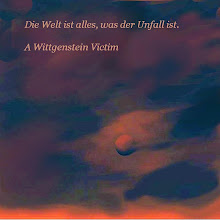
Die Welt ist alles, was der Unfall ist.
A Wittgenstein Victim

4. 
“achtung.
was besteht, ist veraltet.”
(Attention.  What exists, is obsolete.)
Oswald Wiener

5.
How to measure that fraction of measurable to immeasurable?

6.
Why is there action and not just nothing?

7.
“Wenn ich der Regel folge, wähle ich nicht.
Ich folge der Regel blind.”
(When I follow the rule, I do not choose.  I follow the rule blindly.)
Wittgenstein

8.
Open minds are like shared anuses.

9.
Grammar is Theatre

10.
“What is a sadist?”
“Someone who likes to dish out pain.”
(Older youth instructing younger youths on evening rush hour train from Oxford to Didcot Parkway)

11.
If there is no perfect logic, does it mean there is no logic?
If a thing is not perfect, does it mean it is not that thing?

12.
Aesthetic Pain

13.
Everything is allowed as long as it’s insincere.
Confession of Insincerity

14.
The poet is not bad (maudit), language has a certain badness just waiting for the one, who is expected to arrive.

15.
To be true to an event, which ended in defeat, is to be true to a lost cause in its aspect of lostness – it is to be true to lostness, not to Revolution.

16.
For years we resented the false emotions of others, until we realized they were our own and our best possessions.

17.
The gentleman is the real valet.  Only another gentleman can use him with no remainder.

18.
My sensations may be like everybody else’s, but my ataraxy is my own.

19.
Errors are immortal.

20.
“Logik der Empfindung und Fantasie.  / Logik ist schlechtweg Grammatik.”
(Logic of Feeling and Fantasy.  /  Logic is simply grammar.)
Novalis


21.
“Dans le monde réellement renversé, le vrai est un moment du faux.”
(In a really upside down world, truth is a moment of falsehood.)
Guy-Ernest Debord


22.
The stronger the urge, the closer it comes to passion, the more treacherous it was, the higher its content of falsehood, so that we have processed ourselves into that desirable phantom in the centre of all blind instinct, a will full of lies. 
Our Will is the Grand Lie of Being.

23.
Not even madness can cure cowardice.

24.
Your Empire needs you.

25.
“Ich kann ihn suchen, wenn er nicht da ist, aber ihn nicht hängen, wenn er nicht da ist.”
(I can look for him when he is not there, but I cannot hang him, when he is not there.)
Wittgenstein

26.
What does it mean to say that someone is lost, although not physically lost?  Does he know he is lost?  Or to say of someone that he is broken?  What is it, which is lost or broken?  Does he know when he is broken?

27.
There is something of the despot in both the artist and the philosopher.  The work of art or work of philosophy expects absolute obedience.  Each implies the will to absolute power – to completely possess and compel the ‘hypocritical’ Other.


Monday, 16 November 2009

Mallarmé's 'Grand Jeu'


"The automaton moon above the forest of numbers - every star an official secret"

What does the game of dice mean for Mallarmé?  ('Today's game has blinded me' - Hafis)  His premise: no throw of the dice can abolish chance.  Isn't that obvious?  Why would a game of chance be designed to suspend or destroy its own conditions - chance?  If it were possible - would that be desirable?  Is it a tragedy that chance survives all or any throws of the dice?  Wouldn't life be even more boring without chance?  Isn't chance the only guard against  ennui and tyrannical habits?  One often speaks of pure chance.  Although chance has nothing pure about it.  Chance is indiscriminate and banal and reeks of the mechanical.  I would rather abolish a duty than leave it to chance.  Chance is something which interrupts a set course.  It is a non-intelligent intelligence which surpasses and limits the 'Absolute'

"faux manoir
              tout de suite
                        évaporé en brumes

                      qui imposa
                           une borne à l'infini"  ("Un Coup de Dés")

- yet chance and law are never far apart - if only the law of probability and stochastic processes.  Chance refers commonly to all phenomena which appear to take place without the interference of some sort of conscious Will - as if of their own accord.  But chance itself interferes in the phenomenon of Will.  The reasons for things called 'chance' are simply unknown.  Chance is just another name for the unknown or not yet known or semi-unknown.   Chance is not necessarily unforeseeable or even surprising. Otherwise how would one be able to predict some sorts of chance to a fairly accurate degree - like the movements of the stock market or the outcome of horse races.  Successful predictions do not abolish chance either.  The idea of risk is a limit to chance - it implies those circumstances when chance outweighs predictability - one risks the difference.  Risk is on one side - chance is on the other. 


Someone who has no chance is a person whose situation is probably completely known.  As Odilon Redon says in a journal entry dated 1908 "Le peintre qui a trouvé sa technique ne m'interesse pas."(An artist who has found his technique does not interest me. "à soi même, journal 1867-1915", 1989, p.110)  There is no lingering remnant of the unknown or "l'imprévu", the unforeseen.  All is lit up.  Curiously this situation is considered hopeless.  Humans associate hope with the unknown - when much is still in the dark and vague.


Vagueness is a great inducement for thinking.   Once Wittgenstein began to contemplate the properties of vagueness he became disenchanted with the clear-cut world of logical atomism.  "Grammar", the demiurge of his later philosophy, is the epitome of vagueness.  The real futility, the exhausting kind, is the attempt to efface certain iron rules of logic.  Unfortunately, one never knows exactly what these are.  But even the most unassailable logic can never compel belief.


What is the relation between vagueness and chance?  Is chance vague?  Are bodies vague or is vagueness only an attribute of language or other forms of representation?  Does vagueness occur first in thought?  Thoughts can be very vague - as can perceptions.  Every thought, says Mallarmé, is a throw of the dice.  Then are throws of dice also vague?  Vague thoughts, perceptions and language are on one side and on the other side are bodies which are not vague.  Vagueness has no empirical substance.  Although memories of empirical reality can also be very vague, especially memories of feelings. 


The exactitude of language camouflages the inexactitude of thoughts - one can substitute vagueness for inexactitude - feeling, memory or perception for thought .  Only rarely, does inexact language disguise exact thoughts.  Novalis says though - the vague or indeterminate moods augur happiness. 


Friday, 13 November 2009

Baroque Quantities


If the Enlightenment was the Age of Reason, we are living in a new Baroque
Age of the Body.  Wittgenstein was one of its early thinkers.  With his radical
discovery – ‘Philosophy is dead! Everything is allowed!” – he liberated
philosophy from the burden of truth and logic.  Philosophy could become
businesslike and insincere.  Some today like Alain Badiou profess to bring back
truth, but it’s not the same.  History is truly irreversible.  You can never go
home again.  Not only is philosophy dead, the Critic is also an anachronism, as the Futurists already declared.  The Critic discloses the ‘behind the scene’ – but the behind has collapsed.  All that remains is inside the Scene.  ‘Outside’ is a fatal illusion sustained by the world of action.  Everywhere is anywhere and it all looks alike.  There is no way out and no way in. 
A similar time was the Baroque.  The forms of the Baroque are hermetic and
all on the surface.  They envelop and enclose.


1.
Aesthetic Pain – New Baroque


If quantity were not in itself a pain, why would one attempt to soothe it by 
allowing for inexactitude?  But is exactitude only to be found in quantity?  One 
cannot escape quantity by being inexact – the quantity in its real state is not 
less because it is represented inexactly.  Exactitude and inexactitude are found 
in language and other systems of measurement, like truth and falsehood.  The 
false scale.  Quantity has the rhythm of monotony.  The constancy of quantity 
is its quality. This is a source of pain.  To exactly follow a rule is not 
necessarily a question of quantity – a rule can be ‘broken’ in an unknown 
number of ways, none of which need be numerical.  The way to guarantee the 
least inexactitude in following the rule is to diminish the gap between the 
rule/order and obedience to it.  The gap should aspire to zero.  The rule and 
the following of the rule should be nearly identical.  Closeness of the rule to 
the following of it is the primary quality of the rule.  It is the same closeness as 
in the monadic enclosure.   This is also a way of defining baroque art or 
aesthetic – the least possible distance to the object.  The romantic aesthetic or 
poesis is seemingly opposed to this baroque adhesiveness of the vision and the 
visible  – the romantic perspective is a function of distance and the poetic 
elevation of an object by moving away from it.  The idea of distance: 
everything seen from a distance is gilded in mystery, poetry.  When distances 
fade or disappear, what sort of state sets in?  Threat and prose – that which 
seems unavoidable.


The baroque body or ‘bare life’ does not follow the rule-law, he is the body of the law.  
The gap or void between the rule and obeying the rule is closed or filled in by 
the body.  This recalls the baroque “allegorizing of the physis”(Benjamin) in 
the tragedies of the martyr-tyrant.  The tyrant who has been the law of 
absolute power remains that law as martyred corpse.  As a live tyrant or dead 
martyr – he is the indissoluble unity of body and law.  Agamben’s prime 
example of the gapless unity of rule and obedience is the Führer’s voice.  All of 
Wittgenstein’s rule dilemmas seem to be resolved in Agamben’s double-bodied hybrid of the baroque tyrant-martyr and the Nazi Führer – and in their alleged mirror image, ‘homo sacer’.


For the Renaissance tyrant or prince, cruelty or pain is a calculated means of 
power, of obtaining it, keeping it.  Pain is a necessary evil as is punishment.  
He thinks like an ancient Chinese philosopher of warfare – power is not a gift of the gods; it must be endlessly studied and evaluated.  For the baroque 
ruler cruelty or pain is a value in itself – as a way to obtain holiness, as a 
source of lust and desire, as the exuberance, superabundance and privilege of 
power.  Being is that which is there (ready to hand) for an audience.  The more 
aesthetic Being is, the more it is there for an audience.  The Body of Pain (the 
world of the unhappy) is Being which is more than just for itself; it is Being 
whose very passivity (powerlessness) metamorphoses through martyrdom into dramatic action.  Pain has the quality of concentrating all of Being in itself as affect.  The drama of martyrdom – pain for an audience – is the unity of the body of grammar and the body of pain.  Pain is itself and its own allegory.  This is an axiom of baroque aesthetics.  In the drama of baroque martyrdom the nothing of powerlessness turns through pain into the everything of power. 


Pain is aesthetic, pleasure is domestic.  Martyrdom is the affirmation of pain.  
The affect of pain, the propensity to suffer, as part of the sentient human 
biology, carries within it the potential transcendent plane – transcendence 
is rooted in the biological organism, not in the ‘soul’.  The allegorical ‘surplus’, 
the remainder of martyrdom is the emblematic corpse.


The German romantics rediscovered this baroque sensibility – as Novalis wrote: “It is curious that the association of sexual pleasure, religion and cruelty has not long since caused people to notice their close relationship and their common tendency.”(Die Enzyklopädie, Werke und Briefe, Stuttgart, 1962, p.493)


Ecstasy is a state of being like beatitude belonging neither to pain nor to 
pleasure.  It goes beyond both, it can blot out pain for its duration and 
individual pleasure vanishes in it like a ray of light in the sun.  It is a fragment of something infinite.  Ecstasy is neither pain nor pleasure, public nor private.  Although perhaps real ecstasy can only be experienced en masse - when the percipient individual is already dissolved into an indistinguishable collective or multitude. 

Ecstasy is one of those Unnameables, Being which is beyond 
language, the magic prison of the Social.  One knows ecstasy is real because 
afterwards it names its sudden price.  In the legends of the saints the body is 
made to suffer for the soul – even without a belief in the transcendent soul, 
surely it cannot just be the body wanting to suffer for the — body?


2.

When a Cold Pervert Turns into a Hot Pervert


Perversion as a literary mood might be classified as either hot or cold.


Bataille is a hot pervert, addicted to cruelty and sex exuding from waste and excess whereas cold perverts like Burroughs favor a certain kind of businesslike efficiency based on opiated sloth.  Bataille for instance was fascinated by photos of Chinese victims of Ling Chi, the slow slicing  torture (‘death by a thousand cuts’), a form of execution reserved for those convicted of high treason or people who murdered their parents - considered low treason.

But when the cold pervert Burroughs turns into a hot pervert in Nova Express towards the end or already at the beginning he gets very hot – hotter even than a hot pervert like Bataille.  In “Pry Yourself Loose and Listen” – everything is very hot.  Hot Hitler, hot Hitler ovens, hot nova ovens, hot Hiroshima and Nagasaki, hot Venus – then the two hot Nova characters conjure up a “Mayan Aztec God” called the “Mayan God of Pain and Fear” who threatens the conjurors who are too hot to notice – that they can’t pay him enough for his Name.  “Remember we keep exact junk measure of the pain inflicted and that pain must be paid in full.” (Nova Express, 1964)     The only way to cool down in Nova is on a cold jissom morning.  What is the ontology of jissom?  A dying word?