Showing posts with label Logic. Show all posts

Thursday, 26 November 2009

Night Sky Quotes


1.
My Night in the Bad Class

2.
“alles was ist ist zuwenig (…)”
(Everything which is is too little.)
Oswald Wiener

3.
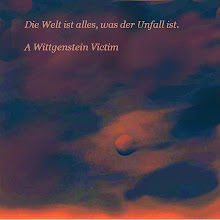
Die Welt ist alles, was der Unfall ist.
A Wittgenstein Victim

4. 
“achtung.
was besteht, ist veraltet.”
(Attention.  What exists, is obsolete.)
Oswald Wiener

5.
How to measure that fraction of measurable to immeasurable?

6.
Why is there action and not just nothing?

7.
“Wenn ich der Regel folge, wähle ich nicht.
Ich folge der Regel blind.”
(When I follow the rule, I do not choose.  I follow the rule blindly.)
Wittgenstein

8.
Open minds are like shared anuses.

9.
Grammar is Theatre

10.
“What is a sadist?”
“Someone who likes to dish out pain.”
(Older youth instructing younger youths on evening rush hour train from Oxford to Didcot Parkway)

11.
If there is no perfect logic, does it mean there is no logic?
If a thing is not perfect, does it mean it is not that thing?

12.
Aesthetic Pain

13.
Everything is allowed as long as it’s insincere.
Confession of Insincerity

14.
The poet is not bad (maudit), language has a certain badness just waiting for the one, who is expected to arrive.

15.
To be true to an event, which ended in defeat, is to be true to a lost cause in its aspect of lostness – it is to be true to lostness, not to Revolution.

16.
For years we resented the false emotions of others, until we realized they were our own and our best possessions.

17.
The gentleman is the real valet.  Only another gentleman can use him with no remainder.

18.
My sensations may be like everybody else’s, but my ataraxy is my own.

19.
Errors are immortal.

20.
“Logik der Empfindung und Fantasie.  / Logik ist schlechtweg Grammatik.”
(Logic of Feeling and Fantasy.  /  Logic is simply grammar.)
Novalis


21.
“Dans le monde réellement renversé, le vrai est un moment du faux.”
(In a really upside down world, truth is a moment of falsehood.)
Guy-Ernest Debord


22.
The stronger the urge, the closer it comes to passion, the more treacherous it was, the higher its content of falsehood, so that we have processed ourselves into that desirable phantom in the centre of all blind instinct, a will full of lies. 
Our Will is the Grand Lie of Being.

23.
Not even madness can cure cowardice.

24.
Your Empire needs you.

25.
“Ich kann ihn suchen, wenn er nicht da ist, aber ihn nicht hängen, wenn er nicht da ist.”
(I can look for him when he is not there, but I cannot hang him, when he is not there.)
Wittgenstein

26.
What does it mean to say that someone is lost, although not physically lost?  Does he know he is lost?  Or to say of someone that he is broken?  What is it, which is lost or broken?  Does he know when he is broken?

27.
There is something of the despot in both the artist and the philosopher.  The work of art or work of philosophy expects absolute obedience.  Each implies the will to absolute power – to completely possess and compel the ‘hypocritical’ Other.


Monday, 16 November 2009

Mallarmé's 'Grand Jeu'


"The automaton moon above the forest of numbers - every star an official secret"

What does the game of dice mean for Mallarmé?  ('Today's game has blinded me' - Hafis)  His premise: no throw of the dice can abolish chance.  Isn't that obvious?  Why would a game of chance be designed to suspend or destroy its own conditions - chance?  If it were possible - would that be desirable?  Is it a tragedy that chance survives all or any throws of the dice?  Wouldn't life be even more boring without chance?  Isn't chance the only guard against  ennui and tyrannical habits?  One often speaks of pure chance.  Although chance has nothing pure about it.  Chance is indiscriminate and banal and reeks of the mechanical.  I would rather abolish a duty than leave it to chance.  Chance is something which interrupts a set course.  It is a non-intelligent intelligence which surpasses and limits the 'Absolute'

"faux manoir
              tout de suite
                        évaporé en brumes

                      qui imposa
                           une borne à l'infini"  ("Un Coup de Dés")

- yet chance and law are never far apart - if only the law of probability and stochastic processes.  Chance refers commonly to all phenomena which appear to take place without the interference of some sort of conscious Will - as if of their own accord.  But chance itself interferes in the phenomenon of Will.  The reasons for things called 'chance' are simply unknown.  Chance is just another name for the unknown or not yet known or semi-unknown.   Chance is not necessarily unforeseeable or even surprising. Otherwise how would one be able to predict some sorts of chance to a fairly accurate degree - like the movements of the stock market or the outcome of horse races.  Successful predictions do not abolish chance either.  The idea of risk is a limit to chance - it implies those circumstances when chance outweighs predictability - one risks the difference.  Risk is on one side - chance is on the other. 


Someone who has no chance is a person whose situation is probably completely known.  As Odilon Redon says in a journal entry dated 1908 "Le peintre qui a trouvé sa technique ne m'interesse pas."(An artist who has found his technique does not interest me. "à soi même, journal 1867-1915", 1989, p.110)  There is no lingering remnant of the unknown or "l'imprévu", the unforeseen.  All is lit up.  Curiously this situation is considered hopeless.  Humans associate hope with the unknown - when much is still in the dark and vague.


Vagueness is a great inducement for thinking.   Once Wittgenstein began to contemplate the properties of vagueness he became disenchanted with the clear-cut world of logical atomism.  "Grammar", the demiurge of his later philosophy, is the epitome of vagueness.  The real futility, the exhausting kind, is the attempt to efface certain iron rules of logic.  Unfortunately, one never knows exactly what these are.  But even the most unassailable logic can never compel belief.


What is the relation between vagueness and chance?  Is chance vague?  Are bodies vague or is vagueness only an attribute of language or other forms of representation?  Does vagueness occur first in thought?  Thoughts can be very vague - as can perceptions.  Every thought, says Mallarmé, is a throw of the dice.  Then are throws of dice also vague?  Vague thoughts, perceptions and language are on one side and on the other side are bodies which are not vague.  Vagueness has no empirical substance.  Although memories of empirical reality can also be very vague, especially memories of feelings. 


The exactitude of language camouflages the inexactitude of thoughts - one can substitute vagueness for inexactitude - feeling, memory or perception for thought .  Only rarely, does inexact language disguise exact thoughts.  Novalis says though - the vague or indeterminate moods augur happiness.